
Before My Second Cup: 4/8/26
Putting Myself Out There

This week, I applied to my first local book fair. Time will tell if all works out for me, but, if it does, it will be the first time I’ve set up a table at an officially bookselling event. I did my own book signing once at a small bookstore owned by a friend’s family member. It was my first published novel, written mostly when I was seventeen and eighteen years old, and it was written under a pseudonym (ha ha). Though I’m proud of the work in a relative sense—I was a teenager, after all—it’s not something I go around recommending to friends and family. The subject matter is dark, to say the least.
This time, I would be showing up with four different books, and I would be in my own city. It’s weirdly gratifying—and a bit intimidating—to do things for my writing in a city I can call my own. The problem with hometowns, especially one as small1 as mine, is that everyone knows you. If you’ve heard that song “In a Lake” from Mitski’s new album, that’s pretty much how it felt trying to do anything as I got older in that town.
Luckily the “first love” wasn’t from my hometown… but he did smell like Monster Energy Drinks,2 so it’s not really a smell I’d ever hope to escape.
I didn’t have a bad time in my hometown; I just was almost too involved in it. At least, that’s what it felt like to me. I remember once, when we had just had my son and were living with my dad in that town, my husband ran to the grocery store and called me because they were out of something I had asked for. I told him it was fine and mentioned an alternative he could grab. My husband loves to mess with people, especially me, so he started going, “Please, please don’t yell. Th-they’re out, I swear. No, not the belt. Please. I can try another store.”
I hissed at him, “Knock it off! Someone I know is probably there.”
It’s a funny memory, but I wasn’t joking when I told him that. And, granted, anyone I knew there would likely get the joke. But it did feel like I was in a constant bubble, a time capsule I couldn’t escape. There are people who were there for me for decades, watching me grow up, but weren’t there for my most transformative time as a person. They never got to know who I became and what I’m like now. So, when they see me, either physically or virtually, I feel like they try to take the pieces of what they see now and put them into places that could make sense on the old me.
It’s hard to explain, but it’s why I didn’t like sharing my art there. They were always supportive, but art requires a dissection of the heart. I didn’t always want the people who still saw ten-year-old me to peek in there. And none of this is a fault of any of them; it’s just the consequence of growing up in a small town.
But now, I live in one of the bigger cities in Washington. There’s no shortage of artists here, and the city welcomes them with open arms. The PNW is good with its writers, particularly its spec fic writers: Frank Herbert, Pierce Brown, Matt Dinniman, Robin Hobb… and that’s just naming the WA writers. One of my favorite active spec fic writers is Brent Weeks, who’s just a few hours away in Oregon.
That being said, calling this city my city is both thrilling and frightening. Fuck-ups here feel more mine than ever before. It’s almost full circle: whatever I do here feels big, whether it succeeds or fails. It’s also frightening to try in a place where so many others are trying, where it can even be considered a hub for my sort of work. But I remind myself of all the daily effort I’m willing to put in, what I’m willing to do to make this work, and all that I’ve already gotten done by my age. It’s hard to keep it in mind when you’re surrounded by those willing to do the few things that really intimidate you, such as putting yourself out there publicly.
Which, as I said this week about the social media schedule, is something I have to improve on. Not many people have this many books at the ready to sell, and yet I’m sitting here doing next to nothing with them. I saw a video a few months ago that said the thing standing between most people and success was shame. While that can definitely be taken to an extreme, there is truth to it, especially for people like me. People who hate making videos, who hate even more when people they know bring them up, who scramble to think of anything “worth posting.” Which is funny when I can sit here and easily ramble on in a post.
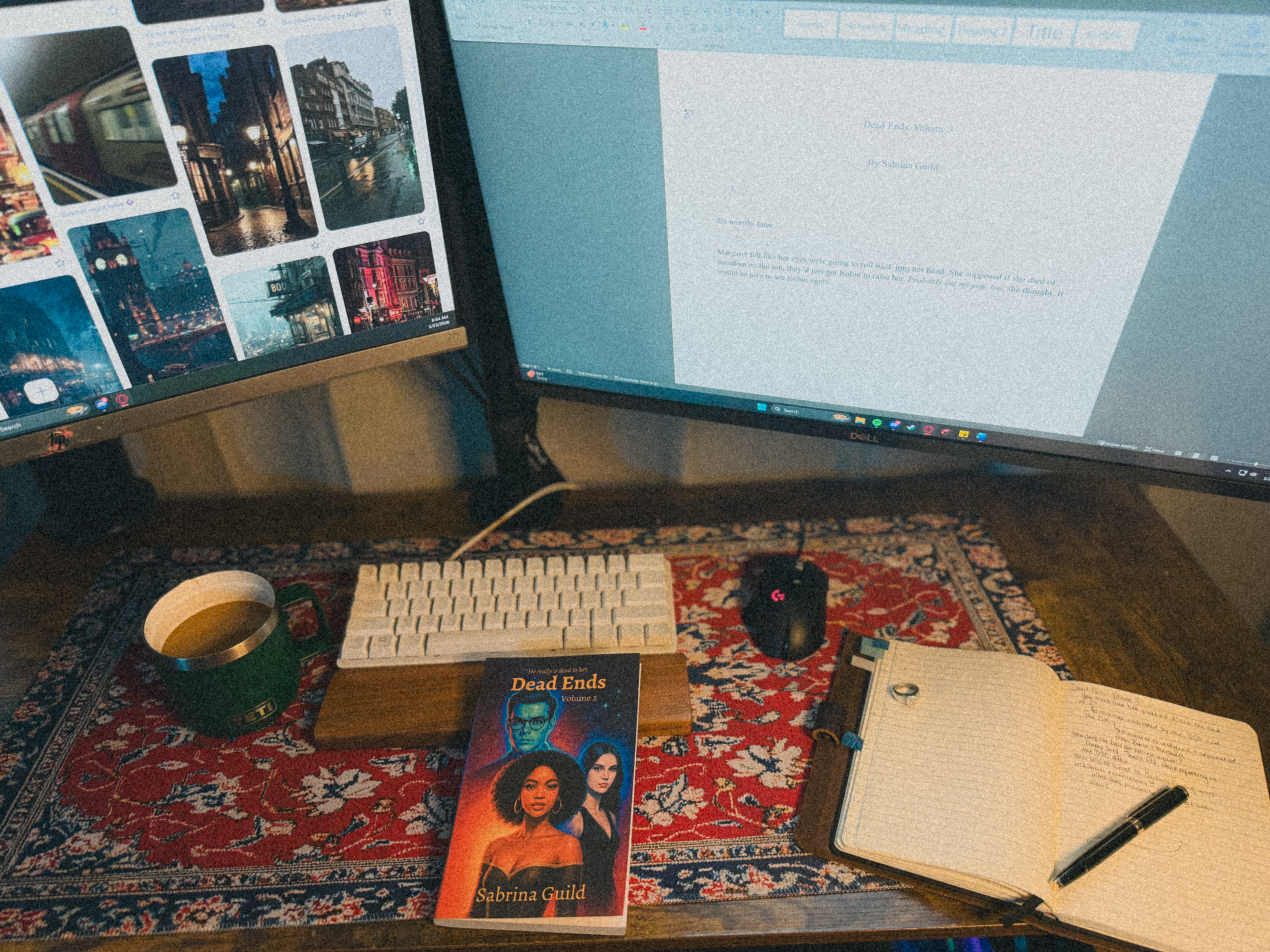
I feel more emboldened than ever as I write Dead Ends: Volume 3. Not only do I have so much love for and faith in this series, but the third volume is hitting a stage that I feel emotionally attached to. I’m watching characters grow beyond their first stages, and I’m seeing more of myself or people I know in fragments of them. Writing Margaret grappling with grief has been both rewarding and, at times, really fun. I know that sounds morbid, but, when you read it, it will make sense.
At the very least, it’s rewarding in the sense that Margaret has grown, that there is more to her than there was in the first pages of Volume 1. Seeing her in new situations with new problems, new emotions, and new friends has let the story spread its wings in ways it never has, and, in a way, feels more emotional than more serious stories that I’ve written.
Yesterday’s scene had me listening to “Such a Funny Way” on repeat. I mentioned to a family member last week that the reason I find myself drawn to Sabrina Carpenter—who, in many ways, is the outlier in my regular rotation of music—is that her last album3 resonated with me. I’m someone that deals with difficult emotions through humor, that makes dry remarks or pokes fun at myself, and Man’s Best Friend is, when you look at the lyrics, full of mostly sad songs. They’re sung in high spirits with fun rhythms and beats, but it’s all to portray that facade you put on when dealing with rejection, insecurity, and heartbreak.
Must be that you want me so much that you don't have the words
Keep me far from friends and family, baby, that's just one of your quirks
And if distance makes you fonder, I'm flattered by the distance you seek
And you know just how to thrill me
Oh honey, how you kill me
And while the lyrics don’t directly apply to Margaret in this moment, I think it’s reflective of her state of mind, of her pushing through every day and trying to act like nothing’s changed. At the very end of the song, Sabrina drops the mask just slightly and allows the pain to surface through the mirth.
It’s funny you’re out drinking
Funny I’m at home
Funny everybody knows something that I don’t
Funny how I do this every single time
So funny that I have to laugh
So I don’t cry.
This whole series feels more and more a testament to how I’ve dealt with difficult things in the past: loss, heartbreak, insecurity, loneliness, etc. It weaves together two of the most difficult and universal things in the human experience: love and death. All this is an attempt to make light in the comparison of the two, to show the crazy things people get driven to when loss of any kind is involved. It’s why I feel it’s more important than ever to put myself out there and share this with the world.
Maybe it’s a little grandiose of me, but you have to be to have any chance in this field. You have to believe that your shout into the void sounds different from the rest and is worth tuning in to.
That being said, it’s time for me to get to work on my social media posts. Wish me luck.
Cheers,
S. Guild
at the time
Do not judge me. This is my Substack, and you don’t get to judge me!
the album that turned me from casual enjoyer to full fan